Press Release · Ant Digital Technologies
Deutsche Bank and Ant Digital Technologies Release White Paper on Agentic Payments in Wholesale Finance
Distributed by PostHackers · Originally issued via PR Newswire
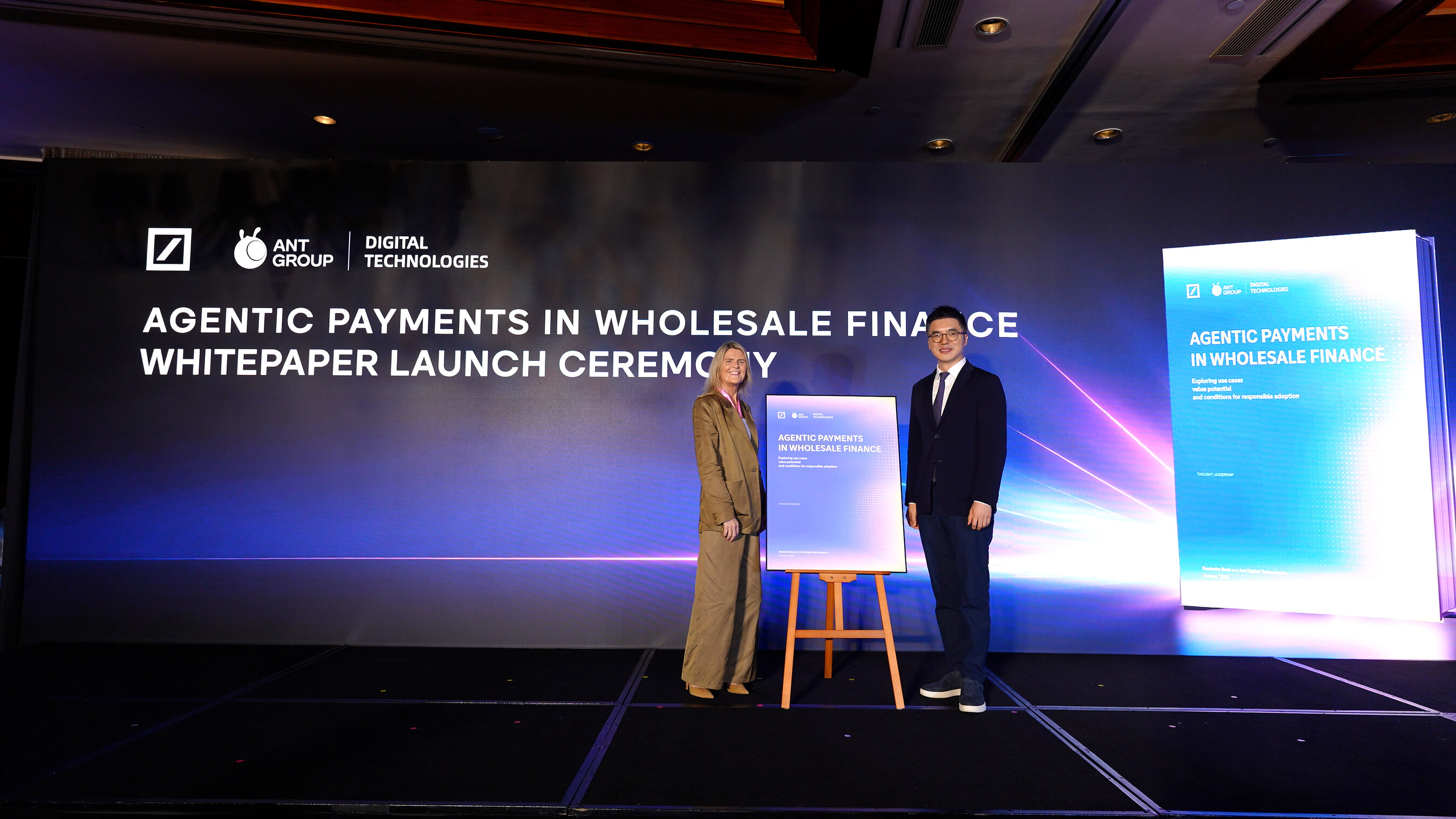
New White Paper Sets Out Roadmap and Safeguards for Integrating Agentic AI into Institutional Treasury, Cross-Border Payments and Trade Finance
HONG KONG, Nov. 9, 2026 — Artificial intelligence (AI) is rapidly evolving beyond insight generation towards systems capable of independently interpreting objectives, evaluating alternatives and executing actions. Against this backdrop, Deutsche Bank and Ant Digital Technologies today announced the joint publication of a white paper entitled Agentic Payments in Wholesale Finance, examining the transformative potential of AI agents in institutional finance and the governance frameworks required to deploy them responsibly.
As AI agents become increasingly capable of carrying out complex financial operations, wholesale financial institutions face a fundamental question: How much authority should be delegated to these agents, and how can their decision-making processes remain secure, controlled and fully auditable?
The white paper's forewords set out the strategic perspectives of both institutions. In his foreword, Sabih Behzad, Head of Digital Assets and Currencies Transformation at Deutsche Bank, highlighted the broader potential of agentic AI:
"The potential value lies not simply in executing payments automatically, but in improving how those decisions are made, coordinated, and controlled."
In her foreword, Zhuoqun Bian, President of Ant Digital Technologies, underscored the importance of a pragmatic, security-first approach to adoption:
"Realising this potential in wholesale finance depends on foundations that are neither optional nor purely technical. Agents need verifiable identity, bound to an accountable owner. Their authority must be explicit, machine-readable, bounded, and revocable. Decision-making, control, and execution must be separated, so that an agent may propose but cannot extend its own authority."
The white paper identifies three key areas in which agentic payments could deliver significant operational efficiencies and strategic value:
- Treasury and Liquidity Management: AI agents can autonomously forecast liquidity shortfalls and surpluses, assess available response options and execute compliant actions across internal fund transfers, investments, external financing and foreign exchange operations.
- Cross-Border Payment Orchestration: AI agents can assess multiple interconnected variables, including foreign exchange rates, payment rails and execution timing, to optimise transaction costs, speed, availability, regulatory compliance and settlement risk.
- Trade Finance: AI agents can interpret complex trade documentation, identify data discrepancies, coordinate exception handling and generate financing or payment instructions once the relevant conditions have been satisfied and the necessary approvals obtained.
While these applications represent a significant advance in the management and execution of complex financial transactions, the report also highlights the governance, accountability and risk management challenges that accompany greater AI autonomy.
Importantly, the white paper advocates an approach based on "bounded agentic execution" rather than unrestricted autonomy. To support the transition from early-stage experimentation to institutional adoption, it draws on the three-layer reference architecture proposed by the International Monetary Fund (IMF):
- Intent and Orchestration: Oversees adaptive agent reasoning, decision-making and workflow orchestration.
- Control and Authorisation: Enforces deterministic, rule-based constraints and ensures that actions remain within predefined authorisation boundaries.
- Settlement: Carries out the final execution of financial transactions.
At the heart of this architecture is a deliberate separation between AI-driven reasoning and the execution of financial transactions. The white paper outlines several essential safeguards within this framework, including explicit, bounded and revocable authorisation limits, robust agent identity binding, and comprehensive Know Your Agent (KYA) verification protocols.
To demonstrate how these principles can be translated into institutional practice, the white paper also features Anvita Flow as a key implementation case study. Developed by Ant Digital Technologies, Anvita Flow is an advanced agentic platform that illustrates how financial institutions can orchestrate complex payment workflows in secure, real-world operating environments while maintaining rigorous controls over agent authority and execution.
The full white paper, Agentic Payments in Wholesale Finance, is now available for download from the official websites of Deutsche Bank and Ant Digital Technologies.
SOURCE Ant Digital Technologies